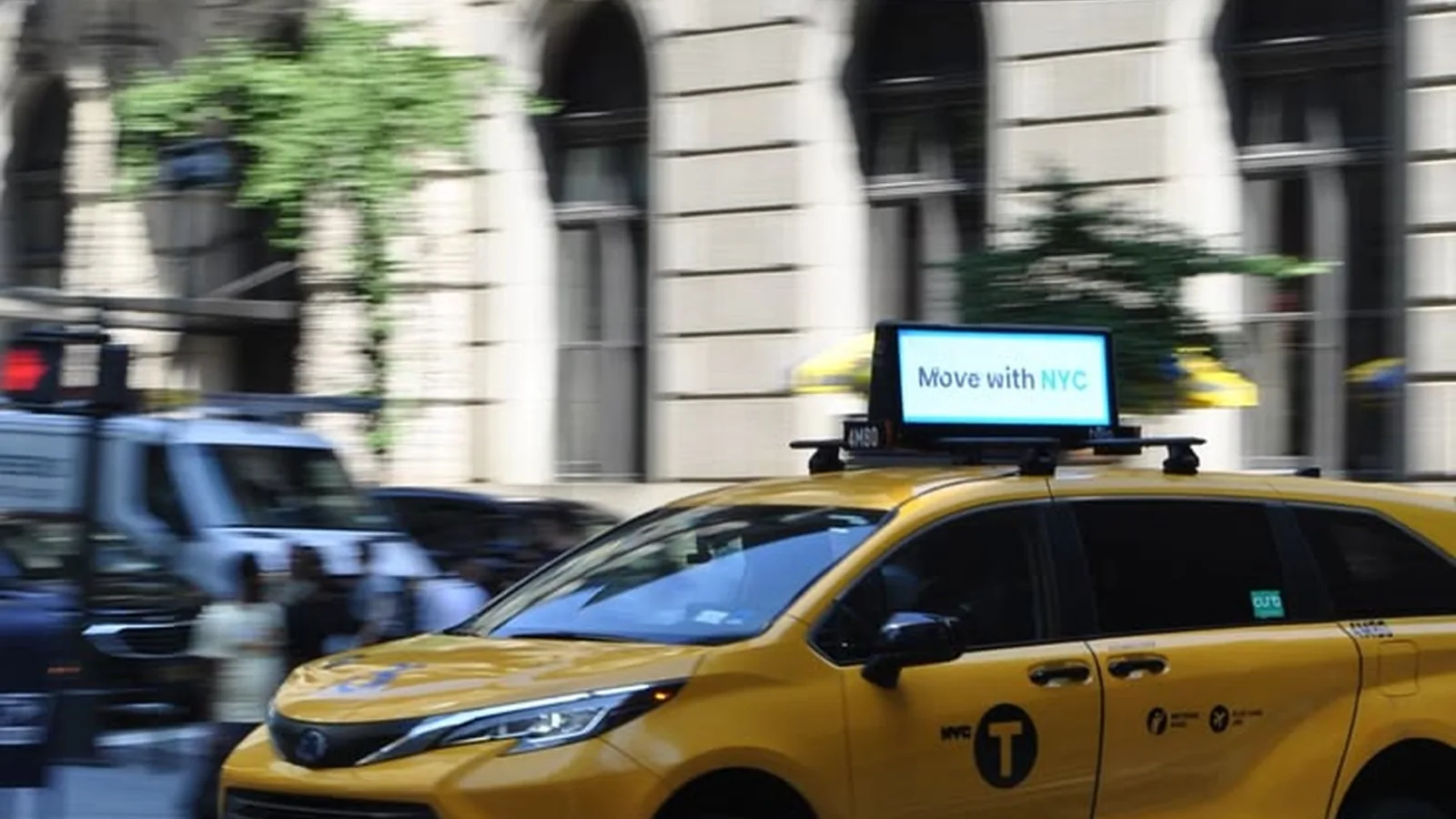
If you take a yellow taxi in New York City in 2026, the price depends on three things: the meter, the required surcharges, and any tolls or tip. For regular in-city trips, the total is not a flat price. It rises with distance and also with time spent stopped or moving slowly, so traffic can materially increase the final fare. The current fare rules are set out by the NYC Taxi and Limousine Commission (TLC), and the congestion-pricing taxi charge is set out by the MTA.
Current yellow taxi fare in NYC in 2026
For a standard metered yellow taxi trip, TLC says the fare is made up of these parts:
- $3.00 initial charge when the trip begins
- 70 cents per 1/5 mile when the taxi is traveling above 12 mph
- 70 cents per 60 seconds when the taxi is in slow traffic or stopped
- 50 cents MTA State Surcharge for trips ending in New York City or certain nearby counties
- $1.00 Improvement Surcharge
- $1.00 overnight surcharge from 8:00 p.m. to 6:00 a.m.
- $2.50 rush-hour surcharge from 4:00 p.m. to 8:00 p.m. on weekdays, excluding holidays
- $2.50 New York State congestion surcharge for yellow taxi trips that begin, end, or pass through Manhattan south of 96th Street
- 75 cents MTA Congestion Relief Zone taxi charge for taxi trips to, from, within, or through the congestion zone in Manhattan south of and including 60th Street, with the exclusions listed by the MTA and TLC
- Any tolls and tip if applicable. TLC fare page; MTA congestion pricing page
In practical terms, every 1 mile of travel at normal speed adds about $3.50 to the meter because there are five 1/5-mile increments in a mile. Waiting in traffic can add just as much, because each minute in slow traffic adds another 70 cents. That is why two trips covering the same route can end with different totals. TLC fare page
What the meter means in plain English
A yellow taxi meter in 2026 starts at $3.00. After that:
- If the cab is moving faster than 12 mph, you pay by distance.
- If the cab is crawling in traffic or stopped at lights, you pay by time instead.
That means the meter is really charging for whichever is happening at the moment: distance at normal speed or time in congestion. For New York riders, this is the most important pricing fact to understand: heavy traffic raises metered totals even on short trips. TLC fare page
Surcharges you should expect
MTA State Surcharge
TLC lists a 50-cent MTA State Surcharge on trips that end in New York City or in Nassau, Suffolk, Westchester, Rockland, Dutchess, Orange, or Putnam counties. For most visitors and most local taxi trips, this charge applies. TLC fare page
Improvement Surcharge
TLC also adds a $1.00 Improvement Surcharge to taxi fares. This is a standard part of the fare structure, not an optional fee. TLC fare page
Overnight surcharge
If your trip starts during the overnight period, add $1.00. The overnight window is 8:00 p.m. to 6:00 a.m. daily. TLC fare page
Rush-hour surcharge
If your trip is during 4:00 p.m. to 8:00 p.m. on weekdays, excluding legal holidays, add $2.50 for a standard metered taxi trip. TLC fare page
New York State congestion surcharge
For yellow taxis, the state congestion surcharge is $2.50 when a trip begins, ends, or passes through Manhattan south of 96th Street. This is separate from the MTA congestion-pricing taxi charge below. TLC fare page
MTA congestion-pricing taxi charge
The MTA says TLC-licensed taxis do not pay the standard daily Congestion Relief Zone toll. Instead, passengers pay a per-trip charge of 75 cents for taxi trips to, from, within, or through the zone. The zone is generally Manhattan south of and including 60th Street, with exclusions including the FDR Drive, West Side Highway/Route 9A, and the Hugh L. Carey Tunnel connections to West Street. MTA Congestion Relief Zone rules; TLC fare page
Because the state congestion surcharge uses 96th Street and the MTA congestion-pricing taxi charge uses 60th Street, some trips trigger both, some trigger only the state surcharge, and some trigger neither. That distinction matters for short Manhattan rides. TLC fare page; MTA Congestion Relief Zone rules
Airport fees, airport fares, and toll rules
Airport Access Fee at JFK and LaGuardia
TLC lists an Airport Access Fee of $2.00 for pickups only at John F. Kennedy International Airport (JFK) and LaGuardia Airport (LGA). If you are picked up at either airport in a yellow taxi, this fee is added. TLC fare page
JFK trips
For trips between Manhattan and JFK in either direction, TLC sets a flat fare of $70. On top of that flat fare, add:
- 50 cents MTA State Surcharge
- $1.00 Improvement Surcharge
- $5.00 rush-hour surcharge from 4:00 p.m. to 8:00 p.m. on weekdays, excluding legal holidays
- $2.50 New York State congestion surcharge if the trip begins, ends, or passes through Manhattan south of 96th Street
- 75 cents MTA congestion-pricing taxi charge if the trip is to, from, within, or through the Congestion Relief Zone
- Airport Access Fee of $2.00 for pickups only at JFK
- Any tolls and tip. TLC fare page
For trips between JFK and other New York City destinations outside Manhattan flat-fare rules, TLC says the fare is the standard metered fare instead. TLC fare page
LaGuardia trips
Trips to and from LaGuardia use the standard metered fare, not a Manhattan flat fare. TLC adds a $5.00 LaGuardia surcharge, plus all other applicable surcharges. If you are picked up at LaGuardia, also add the $2.00 Airport Access Fee. TLC fare page
Newark trips
Trips to Newark Liberty International Airport (EWR) use the standard metered fare plus a $20.00 Newark surcharge. TLC also says passengers pay tolls to and from EWR, meaning the rider is charged for the driver’s return tolls as well. Tip is extra. TLC fare page
Tolls
TLC says drivers must use E-ZPass when taking a toll bridge or tunnel, and the discounted E-ZPass toll is added to the passenger fare. Passengers must pay tolls for specific trips including:
- Newark Airport trips
- Trips to Westchester and Nassau counties
- Trips over the Verrazzano-Narrows Bridge, Cross Bay Veterans Bridge, and Marine Parkway-Gil Hodges Memorial Bridge. TLC fare page
For airport budgeting, this means Newark can be notably more expensive than the meter alone suggests because tolls are a required add-on. TLC fare page
How much should you tip?
TLC includes tips as part of what riders may pay, but tipping itself is not a required government-set surcharge. In practice, many riders tip based on the pre-tip fare total, often around 15% to 20% for normal service. Because tip is discretionary, your actual total can vary even when the meter and surcharges are the same. TLC also notes tips are extra on airport and metered trips. TLC fare page
Worked examples for Manhattan trips
These examples use the current 2026 TLC meter and surcharge rules. They are estimates for understanding the fare structure, not guaranteed prices. Traffic affects metered totals, because each minute in slow traffic adds 70 cents. TLC fare page
Example 1: Short uptown Manhattan trip outside surcharge zones
Route example: Upper West Side, about 1.0 mile, entirely north of 96th Street, midday on a weekday, normal traffic.
Estimated fare:
- Initial charge: $3.00
- Distance charge: $3.50 for about 1 mile
- MTA State Surcharge: $0.50
- Improvement Surcharge: $1.00
- Congestion surcharges: $0
- Rush/overnight: $0
Estimated pre-tip total: $8.00
With a 20% tip, the rider would pay about $9.60.
Example 2: Short Midtown trip that triggers both congestion charges
Route example: About 1.0 mile within Midtown, entirely south of 60th Street, midday, moving traffic.
Estimated fare:
- Initial charge: $3.00
- Distance charge: $3.50
- MTA State Surcharge: $0.50
- Improvement Surcharge: $1.00
- NY State congestion surcharge: $2.50
- MTA congestion-pricing taxi charge: $0.75
Estimated pre-tip total: $11.25
With a 20% tip, total would be about $13.50.
Example 3: Same Midtown trip in heavy traffic during rush hour at night? Not possible together
It helps to separate the surcharge windows correctly. TLC’s rush-hour surcharge is 4:00 p.m. to 8:00 p.m. weekdays, while the overnight surcharge is 8:00 p.m. to 6:00 a.m. The two windows do not overlap. TLC fare page
So take a 1-mile Midtown trip at 5:30 p.m. on a weekday with 10 minutes of slow traffic:
- Initial charge: $3.00
- Distance charge: about $3.50
- Waiting/slow traffic time: $7.00 for 10 minutes
- MTA State Surcharge: $0.50
- Improvement Surcharge: $1.00
- Rush-hour surcharge: $2.50
- NY State congestion surcharge: $2.50
- MTA congestion-pricing taxi charge: $0.75
Estimated pre-tip total: $20.75
This example shows why traffic matters so much: the same basic route can cost far more when the cab is inching along. TLC fare page
Worked examples for airport trips
JFK to Manhattan
For a trip from JFK to Manhattan, start with the TLC flat fare of $70. A common non-rush-hour, non-toll budgeting example for a destination in Manhattan south of 60th Street is:
- JFK-Manhattan flat fare: $70.00
- MTA State Surcharge: $0.50
- Improvement Surcharge: $1.00
- Airport Access Fee for JFK pickup: $2.00
- NY State congestion surcharge: $2.50
- MTA congestion-pricing taxi charge: $0.75
Estimated pre-tip total: $76.75, plus any tolls if applicable.
If the trip starts during weekday rush hour from 4:00 p.m. to 8:00 p.m., add the $5.00 rush-hour surcharge, bringing the estimate to $81.75 before tolls and tip. TLC fare page
Manhattan to JFK
For a trip from Manhattan to JFK, the same $70 flat fare applies in either direction between Manhattan and JFK. A trip from Lower Manhattan would typically also trigger:
- $0.50 MTA State Surcharge
- $1.00 Improvement Surcharge
- $2.50 NY State congestion surcharge
- $0.75 MTA congestion-pricing taxi charge
- Any tolls and tip
Because the Airport Access Fee is for pickups only at JFK or LaGuardia, it would not apply when you are picked up in Manhattan and dropped off at JFK. TLC fare page
LaGuardia to Manhattan
A yellow taxi from LaGuardia to Manhattan is metered, not flat fare. Suppose the metered portion comes to $32.00 in moderate traffic for a trip into Midtown or the Upper East Side. Then add:
- LaGuardia surcharge: $5.00
- Airport Access Fee for LGA pickup: $2.00
- MTA State Surcharge: $0.50
- Improvement Surcharge: $1.00
- Possibly $2.50 NY State congestion surcharge if the trip begins, ends, or passes south of 96th Street in Manhattan
- Possibly $0.75 MTA congestion-pricing taxi charge if the trip goes to, from, within, or through the Congestion Relief Zone
So that same ride could be roughly $40.50 before tip if both congestion charges apply, or less if your destination stays outside those zones. Because the base portion is metered, traffic can raise the total significantly. TLC fare page
Manhattan to Newark
A yellow taxi from Manhattan to Newark Airport is metered, with these major additions:
- Standard metered fare
- $20.00 Newark surcharge
- Tolls to and from EWR, including the driver’s return tolls
- Tip
- Plus any otherwise applicable surcharges, such as the 50-cent MTA State Surcharge, $1.00 Improvement Surcharge, and congestion-related charges if the route qualifies under TLC’s rules. TLC fare page
If the metered part of the trip were $45.00, the subtotal before tip could easily become:
- Metered fare: $45.00
- Newark surcharge: $20.00
- MTA State Surcharge: $0.50
- Improvement Surcharge: $1.00
- NY State congestion surcharge: $2.50
- MTA congestion-pricing taxi charge: $0.75
- Plus round-trip tolls charged to the passenger
That would be $69.75 before tolls and tip, and the tolls can add a meaningful amount beyond that. TLC fare page
Important limitations and exceptions
E-hail app trips may be different
TLC says licensed e-hail providers can offer binding fare quotes for participating yellow taxis. If you request a taxi through one of those apps and accept an upfront quote, the meter will not be turned on and the app’s accepted fare governs the trip instead. This article is about the standard yellow taxi fare structure, not app-based upfront pricing. TLC e-hail guidance
Not every airport trip follows the same rule
- JFK-Manhattan: flat fare in either direction
- LaGuardia: standard metered fare plus $5 surcharge
- Newark: standard metered fare plus $20 surcharge and round-trip tolls. TLC fare page
Zone boundaries matter
The two congestion add-ons use different Manhattan boundaries:
- South of 96th Street for the New York State congestion surcharge
- South of and including 60th Street for the MTA Congestion Relief Zone taxi charge. TLC fare page; MTA congestion pricing page
Bottom line
In 2026, a standard NYC yellow taxi starts at $3.00, then adds 70 cents per 1/5 mile or per minute in slow traffic, plus standard surcharges. For many ordinary Manhattan trips, the minimum realistic total is usually well above the meter start once the 50-cent MTA State Surcharge and $1.00 Improvement Surcharge are included. Trips in Manhattan south of 96th Street often add another $2.50 state congestion surcharge, and trips involving the Congestion Relief Zone add 75 cents more. Airport trips vary sharply: JFK-Manhattan is a $70 flat fare, LaGuardia is metered plus $5, and Newark is metered plus $20 and round-trip tolls. Above all, remember that traffic affects metered totals, so the same route can cost much more at busy times.